The medical robotics market is booming, with annual growth rates of 16–17% and projected revenues of USD 72.54 billion by 2035. However, strict certification requirements, particularly from the FDA (USA) and CE MDR (Europe) – pose significant challenges for startups and new entrants. Approval costs for Class III devices like surgical robots can easily reach double-digit millions before any revenue is generated, while hospitals face high upfront investments (USD 1.5–2.5 million per system) and annual maintenance fees (USD 125,000–180,000).
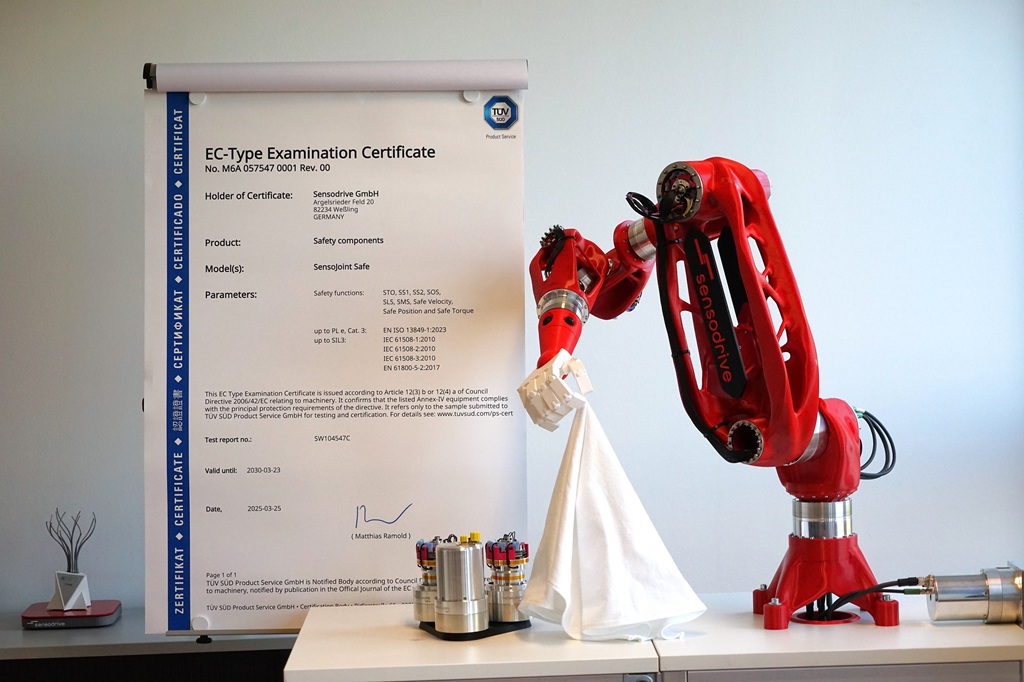
German company Sensodrive addresses this issue by offering SensoJoints, the world’s first torque-controlled robot axes with full safety certification (IEC 61508, SIL3/PL e). These pre-certified modules eliminate the need for manufacturers to develop their own validation software or redundant sensor systems, significantly reducing development time and costs. By integrating SensoJoints, robot developers can directly feed certified torque signals into safety controllers, bypassing months of low-level safety validation.
The benefits are substantial: prototype development time can be reduced from years to months, with the transition from proof-of-concept to pre-series production accelerated by 30–50%. For platform manufacturers, this means focusing on core competencies like software, user interfaces, and AI-driven data processing, while specialists like Sensodrive handle compliance. In this way, safety certification transforms from a barrier into a competitive advantage, enabling faster, more efficient innovation in collaborative robotics.
Key Topics Covered
- Certification challenges facing medical robotics developers
- The role of pre-certified robot axes in reducing development complexity
- How SensoJoints simplify functional safety compliance
- Accelerating time-to-market for surgical and collaborative robotics platforms
- Turning safety certification into a competitive advantage
Download Sensodrive’s whitepaper to learn more.