First Sensor for Surgical Instrument Integration: HEX8 High Force

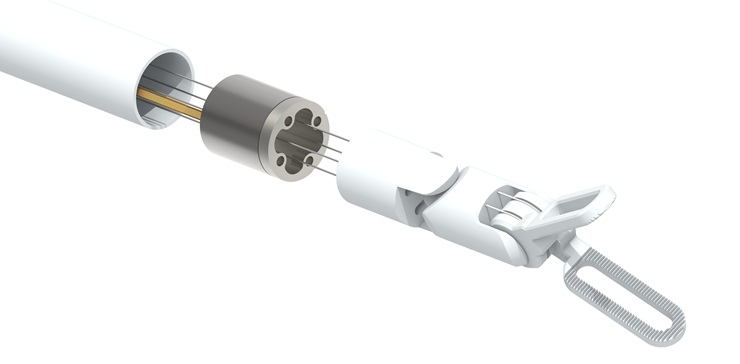
Bringing Force and Torque Sensing Closer to Real-World Medical Robotics
Direct force and torque sensing can provide medical robotic systems with valuable interaction data for more precise control, force feedback, and the interpretation of tool-tissue interactions. Yet integrating force/torque sensors directly into surgical instruments has long been challenging.
HEX8 High Force brings direct six-axis force and torque sensing closer to practical integration in medical robotic instruments by combining a compact, hollow-shaft design with high axial load capacity, sterilization readiness, and a scalable manufacturing concept. Available from Q4/2026.
The Growing Need for Direct Force and Torque Sensing
As medical robotic systems become more advanced, access to reliable interaction data is becoming increasingly valuable. Many existing approaches rely on indirect force estimation based on motor currents, system states, or actuator-side measurements. While these approaches can provide useful information, force and torque data captured closer to the point of interaction offers additional opportunities for control, feedback, and data interpretation.
As a result, developers are increasingly exploring ways to integrate force sensing directly into medical robotic systems without compromising existing designs or workflows. This creates a clear demand for sensing solutions that combine precise multi-axis measurements with the practical requirements of medical device development.
Facing the Big Challenges: Mechanical Integration, High Axial Forces, Sterilizability, and High Volumes
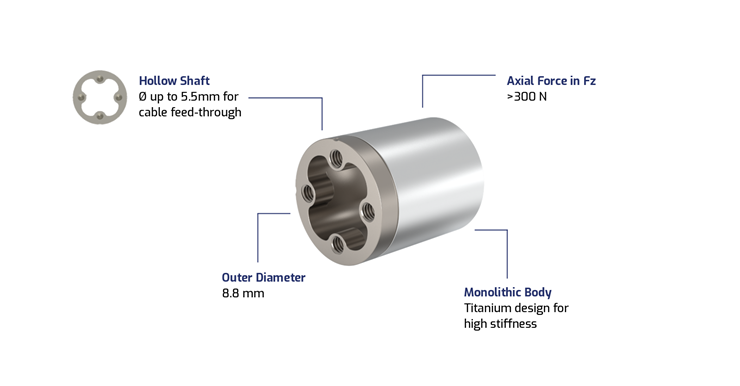
HEX8 High Force was developed to address some of the key challenges. The concept combines compact six-axis force and torque sensing with a central hollow-shaft architecture, enabling integration while preserving valuable installation space, maintaining system functionality, and supporting existing instrument designs.
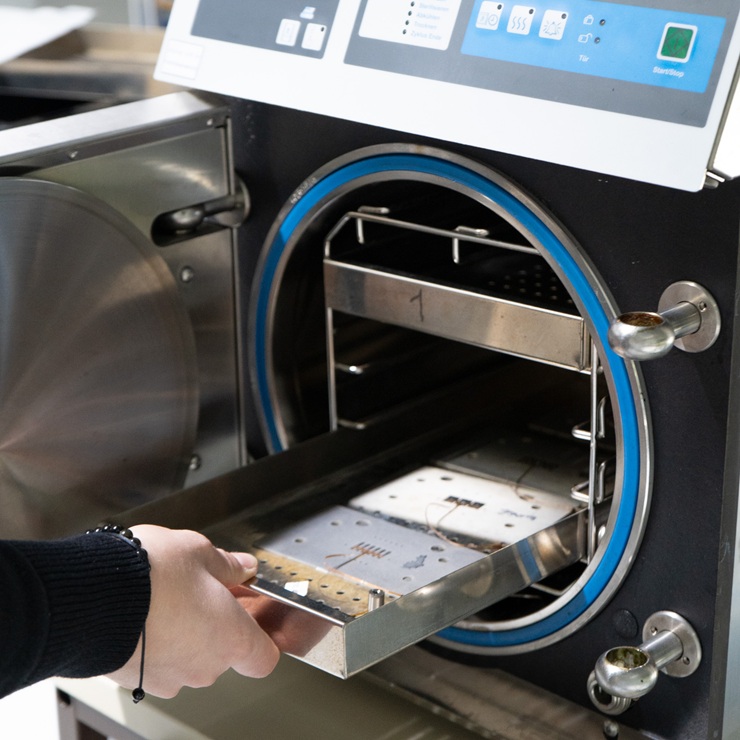
One of the first questions customers ask is whether a sensor can withstand the medical lifecycle. Surgical instruments must survive repeated sterilization processes that can affect materials, bonding, sealing structures, signal paths, and calibration stability. HEX8 High Force is therefore being developed with repeated sterilization in mind and currently targets compatibility with more than 30 autoclaving cycles.
Mechanical robustness presents another important requirement for practical integration. In compact robotic instruments, axial loads caused by insertion, pushing, pulling, friction, or tissue interaction can be significantly higher than the forces that need to be measured. HEX8 High Force addresses this challenge with a target axial load capability above 300 N while maintaining sensitive six-axis force and torque measurement. Scalability is another factor that influences whether a sensing concept can move beyond evaluation and into broader deployment. HEX8 High Force is being developed with scalable manufacturing in mind and targets production volumes of up to 50,000 units per year from 2029, providing a path from prototype evaluation to industrial deployment.
Test HEX8 High Force for Instrument Integration Now: Available from Q4/2026
HEX8 High Force will be available for selected evaluation and integration projects from Q4/2026. Development teams can use this opportunity to assess the sensor directly within their instrument architecture, validate key integration parameters, and generate first application-specific data for future medical robotic systems. If you are currently exploring how to bring direct force and torque sensing into your next-generation instrument design, now is the right time to start the conversation.
Get in touch here to learn more about HEX8 High Force and discuss your application requirements.