 Watch Video
An Overview of the hinotori™ Surgical Robot
In this video, Tetsuya Nakanishi, Managing Director of Medicaroid Europe, provides an overview of the hinotori™ Surgical Robot System and its key features.
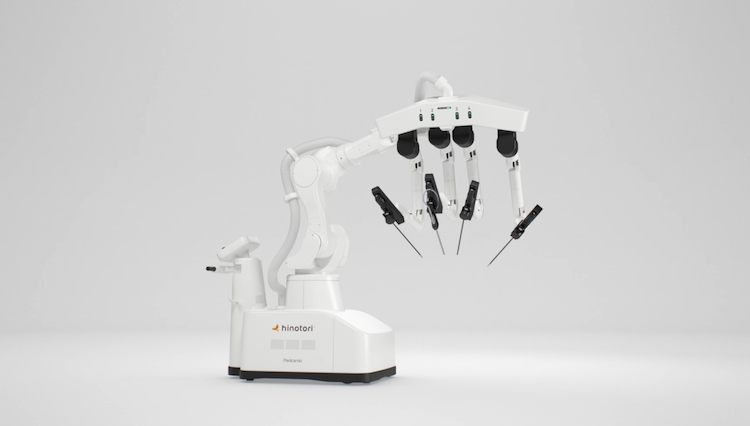
The platform combines precise, flexible robotic arms, intuitive controls, and advanced imaging to support a variety of surgical procedures. Its ergonomic design and intelligent system functions help address surgeon challenges and enhance surgical efficiency, offering a glimpse into the future of robotic-assisted surgery.
hinotori™ was developed as a robotic-assisted surgery system to reproduce the surgeon’s sensitive movement, which is essential for surgeries. What made this possible is Kawasaki Heavy Industry‘s robot technology cultivated for over 50 years and Sysmex Corporation’s network and knowledge in the healthcare field. Medicaroid will pursue the development of new features and services to realise the non-invasive, patient-friendly surgery.
Click here to learn more about hinotori™.
Video transcript:
00:00:05:03 – 00:00:28:15
Let me explain our surgical robot system. So, you can see this is a really slim robot arm. The robot arm has a very slow and smooth motion. You can see inside the body it moves quite fast, but the outside is very slow and has a very smooth motion. This is the exact one
00:00:28:20 – 00:00:50:08
we had at Robot Technology, which we used to imitate the human arm to the robot arm. You can see this is a really flexible motion, like a human arm. The human arm can move, and is very flexible. For example, you can grab here and you can change the posture.
00:00:50:10 – 00:01:16:10
Such a posture is implemented on the robot arm. Which is why we chose to use such a smooth motion. So, you can see around the patient body area, there is a lot of space left. That means, even standing very close to the robot arm
00:01:16:12 – 00:01:45:08
I don’t need to be afraid because the robot has a very slow motion. I also have some more space around here that makes it much easier to work on the patient side. You can use a traditional laparoscopic device from the patient side. This means we can use a hybrid surgery, not only a robotic surgery, but we can use both robot and human on both sides of a hybrid surgery.
00:01:45:08 – 00:02:23:14
So, let’s move to our vision device. We had a cooperation with the Karl Storz , a German company, an endoscope company. We use Karl Storz’s camera system, HF generator, and vision system. We have a very clear 3D, HD system. You can see that this is a very beautiful picture. This makes it easier for the surgeon to perform with such a clear view.
00:02:23:16 – 00:02:53:09’s’
So now we move to the surgeon cockpit here, and our colleague Alexander Schwarz, who is performing the hinotori™ system. We can see there is a wider range of the vision unit, which means that you can change the posture during the surgery. Sometimes during the operation time the surgeon would have a neck ache or a back ache.
00:02:53:09 – 00:03:22:00
This time, you can change the posture to relieve your pain. So, let’s move to the surgeon cockpit. Now, our colleague Alexander Schwarz is performing the surgical robot system. You can see that this visual unit is easy to adjust during the operation time. Sometimes during the operation the surgeon had a neck ache or a back ache.
00:03:22:02 – 00:03:53:17
This time, the surgeon can change the viewer system. This means that you can select your posture if you like. So, like this. With the hand controller of the surgery, he can grab the controller and he can immediately perform surgery. This means it is a very instinctive motion. Like a joystick or a game controller.
00:03:53:23 – 00:04:13:12
You need to learn somehow, but this one is a very instinctive design. That means you can grab the hand controller and immediately start to perform surgery. That means there is a much faster learning curve to perform surgery.