
Smith+Nephew Launches New LEGION™ Hinged Knee System with OXINIUM™ Technology



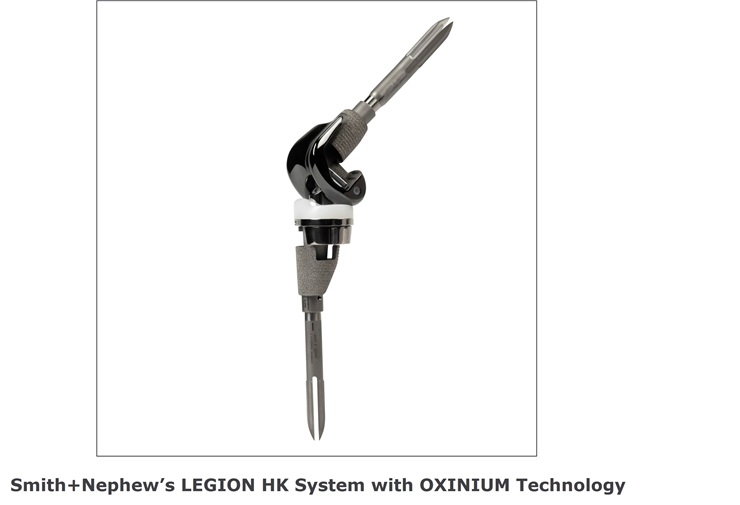
Smith+Nephew has announced that its LEGION Hinged Knee (HK) System is now available in the United States with proprietary OXINIUM (Oxidized Zirconium) implant technology that delivers the durability of metals, the wear resistance of ceramics, and corrosion resistance better than both.1-11
Part of the LEGION Total Knee (TK) System, the LEGION HK System is designed to provide a natural range of motion with medial pivot, lateral roll back, and screw home. Since 2011, the LEGION HK System has enabled surgeons to transition intraoperatively from a constrained revision knee implant to a CoCr-hinged assembly.
The award winning OXINIUM Technology12 has demonstrated lower inflammatory response,*6,7 superior wear resistance and reduced surface damage,+3,4 and fewer signs of corrosion damage+9,13 compared to cobalt chrome, ultimately helping to mitigate common risk factors associated with revision procedures.14,15 LEGION revision with proprietary OXINIUM Technology has established itself as the best performing bearing with the lowest risk of re-revision compared to the class average.13,16
Dr. Kevin Hardt, MD, at Northwestern Memorial Hospital System shares, “The LEGION HK System with OXINIUM Technology allows me to achieve a stable reconstruction in the coronal and sagittal planes despite my patient’s multiple previous surgeries and ligamentous, capsular deficiency. The innovative, posteriorly located, rotational axis with the LEGION HK System provides an extension moment to augment quad function. In addition, the instrumentation is straightforward and compliments my normal revision workflow.”
“Our proprietary OXINIUM Technology is ideal for revisions. Building on the proven performance of our LEGION HK System, our latest innovation allows Smith+Nephew to raise the bar in knee surgery, delivering the most advanced material technology for patients requiring a complex knee revision,” said Craig Gaffin, President of Global Orthopaedics at Smith+Nephew. “It demonstrates our commitment of Life Unlimited for patients requiring complex knee procedures by providing solutions that address the risk factors commonly associated with this type of surgery.”
References
- Hunter G, Dickinson J, Herb B, et al. Creation of oxidized zirconium orthopaedic implants. Journal of ASTM International. 2005;2:1-14.
- Long M, Riester L, Hunter G. Nano-hardness Measurements of Oxidized Zr-2.5Nb and Various Orthopaedic Materials. Abstract presented at: 24th Annual Meeting of the Society for Biomaterials. April 22-26, 1998, San Diego, California.
- Parikh A, Hill P, Pawar V, Sprague J. Long-term Simulator Wear Performance of an Advanced Bearing Technology for THA. Poster presented at: 2013 Annual Meeting of the Orthopaedic Research Society. Poster no. 1028.
- Papannagari R, Hines G, Sprague J, Morrison M. Long-term wear performance of an advanced bearing technology for TKA. Poster presented at: 2011 Annual Meeting of the Orthopaedic Research Society. Poster no. 1141.
- Smith+Nephew 2010. OR-10-155.
- Dalal A, Pawar V, McAllister K, Weaver C, Hallab NJ. Orthopedic implant cobalt-alloy particles produce greater toxicity and inflammatory cytokines than titanium alloy and zirconium alloy-based particles in vitro, in human osteoblasts, fibroblasts, and macrophages. J Biomed Mater Res Part A. 2012;100A:2147-2158.
- Hallab NJ, McAllister H, Jacobs JJ, Pawar V. Zirconium-alloy and zirconium-oxide particles produce less toxicity and inflammatory cytokines than cobalt-alloy and titanium-alloy particles in vitro, in human osteoblasts, fibroblasts and macrophages. Annual Meeting of the Orthopaedic Research Society (ORS), 2012. San Francisco, CA.
- Aldinger P, Williams T, Woodard E. Accelerated Fretting Corrosion Testing of Zirconia Toughened Alumina Composite Ceramic and a New Composition of Ceramicised Metal Femoral Heads. Poster presented at: 2017 Annual Meeting of the Orthopaedic Research Society. Poster no. 1037.
- Smith+Nephew 2016. OR-16-127.
- ASTM International Standard Specification for Wrought Zirconium-2.5 Niobium Alloy for Surgical Implant Applications (UNS R60901) Designation: F 2384 – 10.
- Patrick C, Delhougne G, Patel A. Retrospective Analysis of Oxidized Zirconium Bearing Surface in Hip Replacement 90-Day Episode Claims. ISPOR EU Poster, 2019.
- 2005 ASM International Engineering Materials Achievement Award.
- Cartner J, Aldinger P, Newman M. Characterization of tapers in TKA revisions from a 16-year retrieval database. Poster presented at: Orthopaedic Research Society Annual Meeting; 2016; Orlando, FL.
- Agarwal S, Kabariti R, Kakar R, Lopez D, Morgan-Jones R. Why are revision knee replacements failing? The Knee. 2019;26:774-778.
- Yu S, Bolz N, Buza J, et al. Rerevision Total Knee Arthroplasty: Epidemiology and Factors Associated with Outcomes. Orthopaedic Proceedings. 2018;99-B:Supplement 6. Available at: https://online.boneandjoint.org.uk/doi/abs/10.1302/1358992X.99BSUPP_6.ISTA2016-117.
- National Joint Registry for England, Wales and Northern Ireland: LEGION revision OXINIUM (with revision tibial) implant summary report 15 August 2024. Report available upon request.
*The results of in vitro cytokine expression analyses have not been proven to quantitatively predict clinical cytokine expression.
+The results of in vitro wear simulation testing have not been proven to quantitatively predict clinical wear performance.
Products featured may not be available in individual markets due to regulatory and/or medical practices. Please contact your Smith+Nephew representative if you have questions about availability of Smith+Nephew products in your area.
Source: Smith+Nephew