TX2-60L MedX Ready: One Year Already, And An Entire Ecosystem Coming to Life

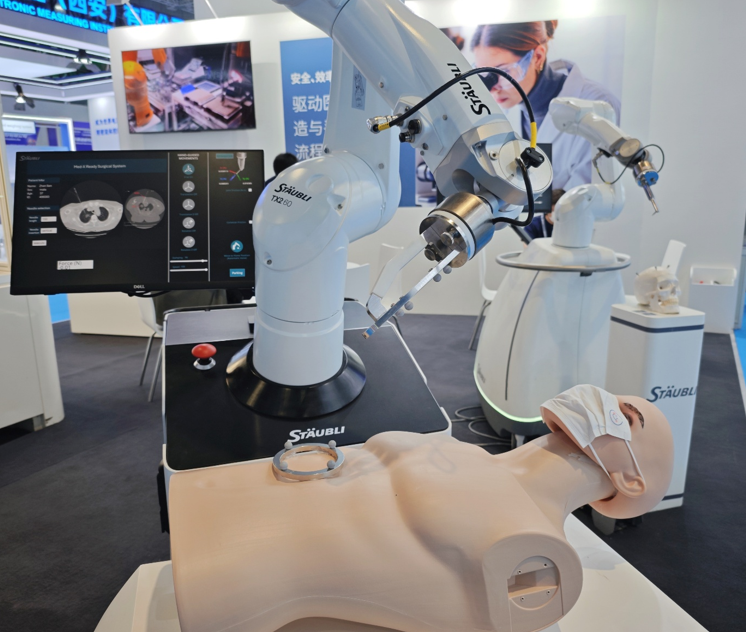
One year ago, Stäubli Robotics launched the TX2-60L MedX Ready, together with MedXguiding, its intuitive manual guidance functionality.
The ambition: to provide medical technology players with a dedicated robotic arm, combining the precision and reliability of industrial robotics with functionalities developed to meet the requirements of the medical sector.
Twelve months later, the TX2-60L MedX Ready has moved beyond the product launch stage. Presented around the world, integrated into new projects and combined with different technologies, it is now at the heart of an ecosystem bringing together robotics, navigation, software, engineering and medical expertise.
A Robot Designed for Medical Innovation
With its six axes and ±0.02 mm repeatability, the TX2-60L MedX Ready meets the needs of applications where precision, rigidity, safety, cleanability and integration are essential.
Its design notably combines hygienic design, absolute calibration, and advanced safety and connectivity functions.
Alongside it, MedXguiding facilitates interaction with the robot thanks to an integrated force/torque sensor. The user can manually guide and position the arm according to different transparency settings and compliance modes.
The objective is not to offer a complete medical device, but a robotic base that manufacturers, integrators and researchers can integrate at the heart of their own solutions.
One Robot, Several Continents
In Europe, the Middle East, China and the United States, this first year has enabled the TX2-60L MedX Ready to meet different medical, scientific and robotics communities.
At WHX Dubai 2026, it was presented as part of Romed:X, notably combined with Atracsys optical tracking to explore new approaches to navigation and guidance.
In the Netherlands, the CareBOTS Event in Veldhoven provided an opportunity to continue discussions with the European medical robotics ecosystem.
At CMEF in China, two demonstrations staging surgical applications illustrated its ability to integrate into specialized surgical concepts.
The journey continued at IEEE/RSJ IROS in Pittsburgh, then at the CAMI Days in Montpellier, close to the research and innovation communities in robotics and computer-assisted medical interventions.
Finally, at the Congrès National de Chirurgie 4.0 in Paris, the Romed:X demonstration with Conicio and SQI illustrated the full value of a collaborative approach.
Different events and different applications, but the same purpose: to provide healthcare innovators with a robotic base to develop, test and validate their future concepts.
From Demonstrations to the First Projects
This first year also marks the transition from launch to commercialization. New projects integrating the TX2-60L MedX Ready are emerging in Europe, China and the United States, involving research centers, start-ups and medical device manufacturers.
Because a medical robotics project often begins with an experimentation or proof-of-concept phase, Stäubli also offers short-term robot loans for evaluation, as well as medium- and long-term rental solutions.
This flexibility allows teams to test the technology under the real conditions of their project before considering permanent integration.
Romed:X: The Ecosystem Takes Shape
This first year is also the year of an ecosystem that is gradually taking shape around the robot.
With Romed:X, Stäubli brings together complementary areas of expertise: robotics with Stäubli, engineering with Conicio, software and regulatory support with SQI, and high-precision optical tracking with Atracsys.
The integration of Atracsys’ forpi™ omnidirectional marker illustrates this approach. In particular, it makes it possible to explore instrument tracking and potential applications such as needle insertion, ENT or foot surgery, and interventional radiology.
The objective: to reduce the distance between an idea, its proof of concept and a validated medical robotics workflow.
Greater Openness with ROS2
This momentum also extends to software.
Thanks to a collaboration between Stäubli Robotics and the ICube laboratory, a first ROS2 driver for the TX2-60L was developed and made available through ICube Robotics.
This openness facilitates its integration into the R&D environments of laboratories, universities, start-ups and developers, where robotics must interact with navigation, perception and planning systems or other medical devices.
Quality as a Foundation
Medical innovation ultimately relies on quality processes adapted to the requirements of the sector.
The Stäubli site in Faverges has been ISO 13485 certified since January 2024. Following recertification, the ISO 13485:2016 certification was renewed for 2027–2030.
Its scope notably covers the development, manufacturing, marketing and servicing of robotic arms and controllers intended for active non-implantable medical devices.
An essential foundation for providing manufacturers with technology developed and produced within a quality management system adapted to the medical sector.
One Year Later, the Story Is Just Beginning
In twelve months, the TX2-60L MedX Ready and MedXguiding have travelled across several continents, explored different surgical applications, integrated new tracking and development technologies, and strengthened their openness to research with ROS2.
But the most important development may lie elsewhere: in the ecosystem being built around them.
Customers, researchers, technology partners, engineers and medical experts now share the same ambition: to transform innovations more quickly into concrete medical robotics projects.