
MMI Raises $125M Series D Funding to Expand Symani Surgical System Adoption Worldwide



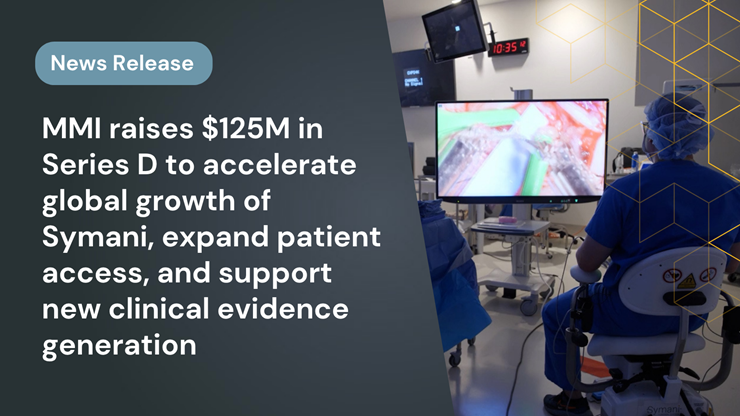
MMI has announced that it has raised $125 million in Series D financing.
The round was led by existing investor BioStar Capital, with participation from new investors S3 Ventures, Angelini Ventures, and an undisclosed strategic corporate investor. MMI’s existing investors also contributed, reflecting strong conviction in the company’s opportunity for continued growth and the expanding adoption of robotic microsurgery globally.
The financing comes as MMI enters its next stage of growth, with approximately 50 installed systems and 3,500 complex microsurgical procedures performed worldwide using the Symani® Surgical System. The capital will support MMI’s continued commercial expansion in the U.S. and key global markets, while strengthening the foundation needed to expand patient access. Investment in clinical trials and outcomes data, including the REMIND study, will also help expand the applications for Symani and support broader adoption.
“We’ve proven there is demand for robotic microsurgery at leading institutions around the world. Now, our focus is translating that adoption into scale,” said Mark Toland, CEO of MMI. “This investment gives us the ability to expand our reach, accelerate adoption and continue advancing the platform through innovation in areas like energy instruments and digital surgery capabilities.”
Scaling Robotic Microsurgery and Advancing New Possibilities
MMI was founded to transform open surgery by extending the capabilities of surgeons at the microsurgical level. As adoption grows, MMI is working with innovation-driven hospitals to develop robotic microsurgery programs designed to bring the capabilities of Symani to more surgeons and patients in need of delicate cancer and trauma-related reconstructive surgery and lymphatic and nerve repair options that improve quality of life.
“We’re excited to lead the oversubscribed round of funding. MMI represents the pinnacle of what we look for at BioStar: a transformational medical technology with the potential to revolutionize patient care and then some,” said Louie Cannon, MD, founder and senior managing director of BioStar Capital. “The most consequential innovations don’t simply improve upon what exists. They create capabilities medicine did not have before. MMI is already demonstrating that in cancer-related lymphedema, and as our scientific understanding of the lymphatic system continues to advance, we believe the company is only beginning to show what those capabilities could mean for patients.”
“The greatest potential for this technology may ultimately lie in areas we are only beginning to investigate,” Toland added. “Through research like REMIND for Alzheimer’s disease, we’re building the evidence and clinical experience that could help define where robotic microsurgery goes next, and the opportunities are remarkable.”
Source: MMI