Unlocking Faster Surgical Workflow With Romed:X and Atracsys Omnidirectional forpiTM Markers

Project Overview
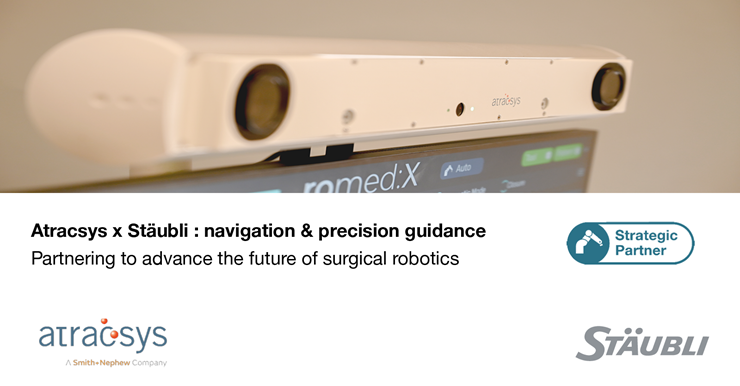
Romed:X is an R&D platform designed to accelerate the development of surgical robotics solutions, that brings together the complementary expertise of several players.
Stäubli provided the robotic arm, enabling precise and repeatable movements within medical settings; SQI contributed its experience in technical validation and prototyping, supporting the development and integration of new concepts; Conicio accelerates innovation by providing a plug-and-play demonstrator, enabling fast integration, validation, and presentation of robotic solutions; and Atracsys furnished its optical tracking technology.
By integrating an Atracsys forpiTM marker, Romed:X explores how optical tracking can support procedures where instrument positioning is not predefined, allowing healthcare professionals to validate more flexible and clinically relevant approaches.
The Challenge
In many emerging applications, needle insertion, feet surgeries, Ear, Nose and Throat (ENT) surgeries or interventional radiology; the key difficulty lies in managing instrument trajectories with multiple possible orientations.
Unlike standardized procedures, these workflows require the system to handle:
- Different entry angles
- Surgeon-dependent positioning
- Unpredictable instrument orientation
As a result, defining a fixed tracking setup in advance becomes impractical. The optimal configuration often depends on the surgeon and the specific case, making setup time longer and less predictable.
The Romed:X Approach
Romed:X combines a robotic arm with navigation capabilities to assist in positioning instruments along planned trajectories.
The system acts as a robotic “third arm”, enabling the surgeon to:
- Enhance surgical accuracy through real-time positioning
- Improve navigation confidence by providing continuous tracking
- Increase procedural flexibility by enabling access to a wider range of anatomical targets
- Optimize operating room efficiency with a compact footprint while reducing setup time
This not only improves targeting speed but also allows the system to reproduce positions consistently, reducing the need to manually search for the correct orientation.
Atracsys forpiTM markers contribution
The Atracsys omnidirectional forpiTM markers address a key limitation at the system level: the need to design and fix a tracking configuration for each specific instrument and use case.
In trajectory-driven applications, it is often difficult to define in advance how a marker should be mounted on the instrument. The optimal configuration depends on the surgical approach, the anatomy, and even the surgeon’s technique, making a one size fits all design impractical.
With a forpiTM marker:
- The marker can be tracked from virtually any angle (360° visibility), making it no longer tied to a single orientation
- The same instrument can support multiple configurations, making integration more flexible across different applications
This enables a higher level of customisation and reusability. For the Romed:X platform, this translates into a more adaptable end-effector, capable of supporting a wider range of trajectories and use cases without requiring specific marker setups for each scenario.
Impact and Conclusion
The integration of a forpiTM marker within Romed:X demonstrates clear benefits:
- Faster setup → easier configuration, reduced preparation time
- Faster targeting → the system reaches and reproduces positions quickly
- Lower cognitive load → no need to manage orientation or visibility
- Improved ergonomics → surgeons can work in their preferred position
By making the system more tolerant to orientation and easier to configure, forpiTM helps reduce one of the main bottlenecks in navigation and robotics: setup time.
Instead of adapting the workflow to the system, the system adapts to the surgeon’s gesture, enabling more intuitive and versatile use.
Romed:X is a proposal for a medical robotic solution. Stäubli Robotics supplies advanced robots for use in medical equipment. The robots alone are not considered to be medical devices.