Articulating Rotary Cutting Tools: Ushering in a New Era of Dexterity in Orthopedic Robotic Procedures


Introduction
Orthopedic surgery is entering a transformative era. As patients demand faster recoveries and healthcare systems push for higher efficiency, surgeons are expected to deliver superior precision through less invasive techniques. Yet, today’s standard tools—particularly straight-line rotary burs and other workhorse tools for joint replacement and spine surgery—often struggle with the complex anatomies of human joints and require a large surgical incision. Limited maneuverability, extended surgical times, and larger surgical exposures resulting in longer postoperative recovery times from the increased disruption the patient’s native anatomy remain persistent hurdles.
The need for innovation is clear. Traditional rotary tools, while reliable, are constrained by their rigidity. Additionally, legacy robotic systems have struggled to offer new capabilities to surgeons beyond navigated implant positioning. Now, articulating rotary cutting tools attached as end effectors to robotic systems are poised to reset the expectations for minimally invasive musculoskeletal surgery, offering a solution that allows for unprecedented precision, efficiency, and control with unfathomably small surgical incisions. By dramatically improving surgical dexterity of cutting instruments around skeletal and soft tissue anatomy, these navigated articulating tools can enable precise bone and tissue resection without compromising surrounding structures, a critical advantage in joint replacement and other minimally invasive surgeries.1,4,5,7 Articulating robotic technology finally upgrades the surgeon’s capability to have a never before realized ability to perform joint replacement or spinal surgery with less soft tissue and tendon disruption, a cornerstone of minimally invasive surgical technique that has proven to yield superior outcomes, fewer complications, and enhanced patient recovery.3
Articulating Tools in Other Fields of Robotic Surgery: A Historical Perspective
The evolution of rigid to dexterous tools in general surgery robotics has been a powerful example to watch, one that continues to usher in new horizons for minimally invasive surgical precision.
In the 1980s, the first robotic surgical systems were beginning to emerge, with an existential goal of upgrading a human surgeon’s manual capabilities. The first notable robotic surgical device, the PUMA 560, was used in 1985 for a brain biopsy, demonstrating the potential for robotic arms to enhance precision by reducing hand tremors. However, these early systems lacked articulating instruments, relying on rigid tools that limited their dexterity compared to the human hand. By the late 1980s and early 1990s, the focus shifted toward improving minimally invasive surgery (MIS), with systems like the PROBOT (1988) and AESOP (1990) introducing basic robotic assistance for tasks like prostate surgery and endoscopic positioning. These systems, while innovative, still used straight instruments, constraining their ability to navigate complex anatomical structures.
A transformative breakthrough came in 1999 when Intuitive Surgical introduced articulating tools as part of their da Vinci Surgical System. For the first time ever, a robotic system featured EndoWrist® instruments with seven degrees of freedom, mimicking and surpassing the human wrist’s range of motion. These tools, first used in cholecystectomies and prostatectomies, allowed surgeons to perform complex tasks such as suturing and dissecting in the tightest of anatomical spaces with unprecedented accuracy.
Articulating tools in general surgery marked a revolutionary advancement for surgical robotics, enabling surgeons to transcend the limitations of the human hand, something that greatly appealed to surgeons worldwide who were skeptical of why robotic aids in surgery were justified. Prior to these innovations, surgical precision was constrained by the hand’s natural range of motion, often making complex procedures in confined or delicate anatomical spaces challenging or impossible. Articulating instruments, with their flexible, multi-jointed designs, allowed surgeons to navigate tight spaces, manipulate tissues at unconventional angles, and perform intricate maneuvers with enhanced control. Moreover, by mimicking and surpassing the human wrist’s flexibility, these instruments enabled access to previously unreachable areas, such as deep pelvic or thoracic regions, without requiring large incisions. This breakthrough expanded the scope of minimally invasive techniques, such as laparoscopy, reducing patient trauma, shortening recovery times, and improving outcomes in procedures like cholecystectomies and colorectal surgeries.
As articulating tools in surgical robotics evolved, surgeons also became more adept at harnessing their capabilities. Complex tasks—such as suturing, knot-tying, or dissecting—were now possible with unprecedented accuracy, even in anatomically challenging environments. This not only broadened the range of operable conditions but also empowered surgeons to tackle high-risk cases with greater confidence. The advent of articulating tools thus transformed general surgery, ushering in an era of enhanced precision, safety, and patient-centered care.
Introducing the Articulator™ Bur: Rethinking Bone Resection
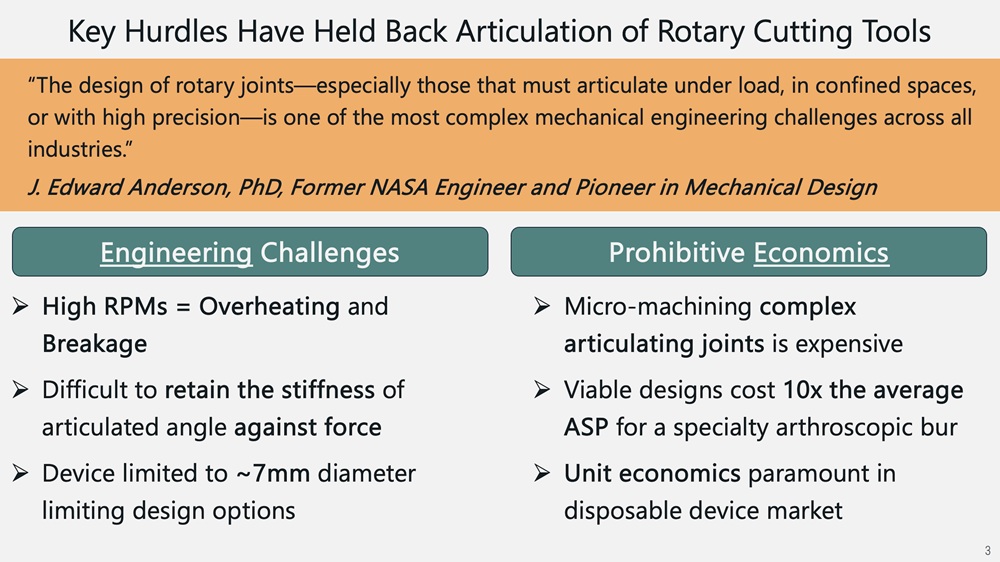
Given the remarkable impact articulating surgical instruments have had in other fields of surgery, miniaturized articulating bone resection tools has long been sought by orthopedic device makers but key engineering and economic hurdles have held back emergence of this technology (Figure 1).
Figure 1. Engineering and economic hurdles that have made articulating rotary cutting bone tools very difficult to develop for surgical applications.
In recent years, however, innovations in mechanical design, material science and machining have made this breakthrough possible for surgical applications. At the forefront of this movement is Joint Preservation Innovations (JPI), an Illinois-based company committed to advancing surgical technology. Their flagship device, the Articulator™ Bur (Figure 2), represents one of the first major leaps forward in articulating rotary cutting instruments for orthopedics. The Articulator™ Bur, with premarket variations adapted for arthroscopy, endoscopic spinal surgery and robotic surgery, features a unique design that offers a 601% greater effective cutting surface compared to conventional straight burs. Its articulating capability allows surgeons to match the natural contours of the anatomy, performing more accurate bone resections with less effort. Constructed from advanced surgical-grade materials, the device ensures high durability, control and reliability even under demanding clinical conditions.
Figure 2. The Articulator™ Burrepresents one of the first major leaps forward in rotary cutting instruments for orthopedics. Its patented design features a best-in-class short radius articulation ability for controlled high speed rotary burring that offers surgeons a 601% greater effective cutting surface compared to conventional straight burs. The acute angle articulating capability allows surgeons to match the natural contours of the anatomy, performing more accurate bone resections with less soft tissue disruption.
With dynamic angulation at the tip, the Articulator™ grants access to difficult-to-reach areas like the inferior humeral head or glenoid in shoulder surgery. The customizable hood allows surgeons to achieve clean resections even when placing the bur in tight spaces, preventing damage to surrounding healthy tissue. This allows the Articulator™ to achieve the goals of bone resection without requiring additional surgical morbidity associated with larger incisions surgeons must utilize currently for straight tools. With less damage to surrounding healthy tissue, many orthopedic procedures can become more minimally invasive—an essential factor in faster recoveries, decreased pain, fewer complications and more consistent long-term patient outcomes.
JPI’s interdisciplinary development approach, combining surgeon input with cutting-edge engineering and materials science, led to a technology built for both performance and practicality. The Articulator™ Bur is engineered to withstand high rotational and axial forces, maintain structural integrity, and offer ergonomic handling, reducing fatigue during longer procedures. This innovation is not just an incremental improvement—it’s a meaningful evolution in surgical instrumentation.
Articulator™ with Robotic Applications: Opening New Doors with Dexterity
A mandate of current orthopedic and spinal robotic systems is to find new ways to “drive the adoption of minimally invasive procedures.2” Articulating bone resection tools could afford a major paradigm shift by allowing bone resection to be performed through a smaller, less disruptive incision due to their ability to enable bone resection in the tightest of anatomical spaces and around structures. Adding Articulating rotary cutting tools as end effectors to hard tissue robots, specifically those that are commonly employed in orthopedic procedures to navigate placement of implants using precise CT based guidance, has the potential to replicate the same MIS benefits flexible, multi-jointed designs allowed in general surgery.3
FDA Breakthrough Device Designation
In 2023, the US Food and Drug Administration (FDA) granted Joint Preservation Innovations a prestigious Breakthrough Device Designation for applications of its Articulator™ Bone Resection platform in surgical robotic and minimally invasive spinal surgery. This coveted award goes to any company whose technology is deemed to be transformative and “in the best interest of patients” suffering from chronic, lifelong diseases like joint degeneration. Articulating bone resection technology, much like its articulating tool counterparts in soft tissue robotics, has potential to greatly expand surgical capabilities into more minimally invasive standards of orthopedic care. As demand for joint replacement solutions that enhance patient outcomes and quality of life grows, surgery with smaller incisions and less soft tissue disruption results in profound benefits of decreased pain, faster recovery and fewer complications let alone improved costs and surgical risks.
Beyond the clinical impact, the Breakthrough Device Designation streamlines the Articulator™ platform’s path to market and enhances its commercial viability. The designation grants JPI expedited FDA review, including prioritized interactions and a Sprint Discussion process, which can reduce regulatory approval timelines by months or even years, accelerating market entry. Additionally, it opens pathways for increased reimbursement through the Centers for Medicare & Medicaid Services (CMS), particularly via programs like the Medicare Coverage of Innovative Technology (MCIT) pathway, which provides immediate national coverage for Breakthrough Devices post-FDA clearance. This ensures broader market access and financial incentives for healthcare providers adopting JPI’s technology.
General Pathway and Framework for Integration with Legacy Robotic Systems
Achieving synchrony between Articulator™ technology and current robotic orthopedic systems that utilize burs is important to realize the dual synergy of articulating cutting ability and navigated resection. The Articulator’ patented short radius distal motion technology, which offers 601% more cutting surface area than standard burs, enables unparalleled access and efficiency in bone resection making it an ideal upgrade for any robotic system that uses a bur during joint or spinal procedures. Adapting the Articulator™ Robotic Bur as a modular end effector for a robotic system provides a pathway to combine the increased dexterity of the Articulator™ system with the robotic platforms’ navigation and haptic feedback systems to improve outcomes.
Fortunately, retrofitting current robotic systems with Articulator™ technology and software upgrades does not require a robotic system to be rebuilt from scratch (Figure 3). Minimal hardware redesign is required for the Articulator™ modular end effector and logistically software integration into legacy systems would involve developing an API (Application Programming Interface) or software update to interface with the robotic system’s control capabilities, ensuring precise control and three-dimensional feedback of the bur’s distal motion. By upgrading bur dexterity with Articulator™ technology and combining it with navigated precision, legacy hard tissue robotic systems stand to gain never before seen capabilities for minimally invasive surgery.
Figure 3. Adapting the Articulator™ Robotic Bur as a modular end effector for a robotic system provides a pathway to combine the increased dexterity of the Articulator™ system with existing robotic platforms’ navigation and haptic feedback systems to improve outcomes. Minimal hardware redesign is required for the Articulator™ modular end effector and logistically software integration into legacy systems would involve developing an API (Application Programming Interface) or software update to interface with the robotic system’s control capabilities, ensuring precise control and three-dimensional feedback of the bur’s distal motion.

Case Example: Shoulder Replacement Using a Subscapularis Sparing Approach
Anatomic Total Shoulder Arthroplasty (TSA) is one of the fastest growing procedures in the United States, with annual procedure volumes having doubled over the last 10 years. To allow surgeons adequate access to the glenohumeral joint, TSA has traditionally been done through an anterior shoulder skin incision along with a takedown of the subscapularis rotator cuff tendon to facilitate resection of diseased arthritic bone and osteophytes. Although these traditional approaches for TSA have generally had good outcomes, some patients, despite advanced methods of meticulous tendon repair, get permanent compromise of subscapularis tendon function and integrity6,7. Insufficiency of this all-important rotator cuff tendon can in turn lead to weakness, TSA instability and glenoid loosening, and patient dissatisfaction requiring revision surgery.
To prevent subscapularis tendon related complications, decrease postoperative pain and considerably speed up postoperative rehab, LaFosse and colleagues developed a technique for TSA using a subscapularis sparing approach4; others have also published on similar approaches.1,7
Subscap sparing TSA techniques hold great promise in revolutionizing TSA experiences for patients given their minimal disruption to native anatomy (Figure 4). Although these novel approaches for minimally invasive shoulder arthroplasty have tremendous potential, the techniques are limited by their ability to resect bone pathology on the inferior aspect of the humeral head and glenoid making widespread adoption of this technique difficult with current surgical tools.
Figure 4. Current approaches for total shoulder arthroplasty involve taking down the subscapularis tendon in some fashion (left) using the tendon incision shown in red. Unfortunately, this process leads to slower rehab and frequently can compromise postoperative results, especially if the repaired tendon heals poorly. Subscapularis sparing total shoulder arthroplasty (right) involves not taking down this subscapularis tendon attachment but rather doing the procedure through the rotator interval (shown in green), or plane between the supraspinatus and subscapularis tendons.

An Articulator™ Robotic Bur as a modular end effector on a robotic system could materialize this long-awaited goal by surgeons performing shoulder arthroplasty by enabling controlled, navigated bone resection around corners, particularly in hard-to-reach areas such as the inferior humeral head and glenoid that are currently very difficult to access with a limited incision into the joint. Subscapularis sparing TSA offers considerable hope in further optimizing the TSA procedure to enable speedier patient recoveries, more consistent post-op function and possibly even expanding the pool of patients who may benefit from TSA (Figure 5).1,4,7
Figure 5. A Subscap sparing approach for total shoulder replacement has a number of clinical advantages for patients.1,4,7 In addition to allowing patients to recover faster and with fewer complications related to poor subscapularis healing or permanent strength deficits in internal rotation, it may also broaden the field of patients being eligible for total shoulder arthroplasty.

A Platform for the Future of Orthopedics
Joint Preservation Innovations’ Articulator™ platform is a revolutionary bone resection technology that can be seamlessly integrated as an end effector into legacy orthopedic robotic systems equipped with bur tools, enhancing precision and functionality in minimally invasive joint preservation procedures. The Articulator’s patented distal motion technology, which offers 601% more cutting surface area than a standard straight bur tools, enables unparalleled access and efficiency in bone resection, making it an ideal upgrade for robotic systems that rely heavily on rotary cutting bone tools. By adapting the Articulator™ as a modular end effector, current robotic systems can leverage their existing navigation and haptic feedback systems to improve surgical outcomes in applications such in joint replacement and spinal procedures. The Articulator’s FDA Breakthrough Device Designation for robotic applications further validates its compatibility and potential to enhance legacy systems, offering strategic partners a pathway to differentiate their robotic offerings with minimal hardware redesign.
References:
1. Desai SS, Nelson RA, Korbel KC, Levine WN, Goldberg SS. Technical note: subscapularis-sparing approach to perform anatomic total shoulder arthroplasty using a multiplanar humeral osteotomy and angled glenoid instruments. J Orthop Surg Res. 2022;17(1).
2. Hu R, Longo UG, Pittman J, Nazarian A. Robotic Innovations in Orthopedics: A Growing Landscape, Challenges, and Implications for Care. Osteology. 2025;5(2):13.
3. Khanna A, Gougoulias N, Longo UG, Maffulli N. Minimally Invasive Total Knee Arthroplasty: A Systematic Review. Orthopedic Clinics of North America. 2009;40(4):479-489.
4. Lafosse L, Schnaser E, Haag M, Gobezie R. Primary total shoulder arthroplasty performed entirely thru the rotator interval: Technique and minimum two-year outcomes. J Shoulder Elbow Surg. 2009;18(6):864-873.
5. Picard F, Deakin A, Balasubramanian N, Gregori A. Minimally invasive total knee replacement: techniques and results. European Journal of Orthopaedic Surgery & Traumatology. 2018;28(3):781-791.
6. Piper CC, Horneff JG. Management of Subscapularis Insufficiency After Total Shoulder Arthroplasty. Journal of the American Academy of Orthopaedic Surgeons. 2022;30(19):933-940.
7. Rosenthal Y, Kwon YW. Total Shoulder Arthroplasty Utilizing the Subscapularis-Sparing Approach. Orthopedic Clinics of North America. 2020;51(3):383-389.
