How Data-Centric Architecture is Redefining the Next-Generation of Intelligent Surgical Robotics

Over the last three years, there has been a rapid acceleration in surgical technology innovation, fueled by advancements in computing and AI. RTI is at an inflection point where technology solutions have the capability to enable a massive leap forward in patient care and clinical efficiency.
This transformation represents a paradigm shift in the design of medtech systems. Innovation is now accelerated by data-driven technologies, requiring digital-first, interoperable, and AI-enabled architectures. This represents a shift from siloed, task-limited devices to integrated, physical AI systems capable of sensing, thinking, acting, and adapting over time.
Fundamentally, these systems must be designed around data. This approach not only ushers in a new era of clinical solutions that leverage high-fidelity digital twins, sim-to-real applications, and real-time AI at the edge, but also simplifies and accelerates the development and deployment of these capabilities.
Access to data and integration are fundamental challenges with legacy MedTech architectures. This is solved by data centricity. Next-generation systems, based on a data centric architecture, enable seamless, real-time data across distributed applications and devices, accelerating development and unlocking the potential for these systems to unleash a new era of automation, imaging, surgical AI, and telesurgery.
At GTC 2026, NVIDIA discussed the necessary shift for next-generation surgical systems to move away from outdated architectures and technology stacks toward a data-centric approach. This article will discuss how this works.
From Data Silos to Data-Centric Architectures
Transitioning from legacy surgical robotic systems to a more flexible data-centric architecture represents a new approach to medical system design. While legacy systems rely on proprietary, siloed, and message-centric digital interfaces, data-centric systems are designed around data flow, creating a unified “nervous system” for connected medical technologies and solutions.
One reason for this transition is that traditional system architectures rely on proprietary, point-to-point connections, signals, and protocols. The custom, non-interoperable nature of these connections makes it extremely difficult to upgrade from one generation to the next, requiring extensive maintenance and leading to obsolescence risks.
RTI see this in other industries, such as automotive, where these disparate protocols and connections are highly complex and inflexible, making the systems hard to maintain, scale, and adapt to evolving data requirements.
Adopting a Data-Centric Architecture for Simplified, Scalable Digital Platforms
As the next generation of surgical robotics moves toward a data-centric design, they become “data-centers on wheels” as they integrate further into a digital ecosystem, spanning applications, devices, third-party platforms, across the operating room and beyond. This shift offers substantial advantages.
Complexity is drastically reduced by providing the data itself as the interface to other applications over a unified connectivity framework. In this way, data centric architectures are highly modular and extensible, allowing for upgradeable internal or external applications with evolving needs for interoperability with sensors, devices, and computing platforms.
Data-centric frameworks are designed to optimize highly-reliable, real-time data flow, which can also be accelerated by offloading communication overhead from the main CPU through accelerated GPU data paths. This is critical to reduce end-to-end latency for data-intensive, physical AI-based systems.

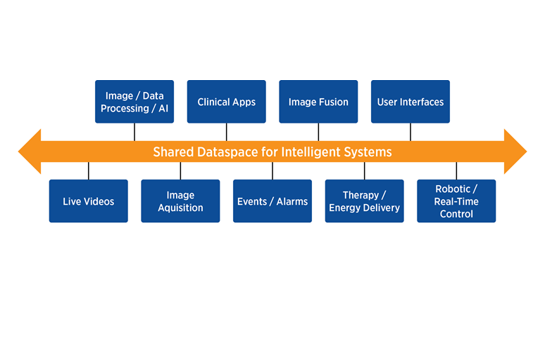
Figure 1: A data centric architecture lies at the heart of next-gen surgical systems. Here, the databus provides continuous data flow, where and when it’s needed throughout the system.
RTI Connext is an example of a standards-based connectivity framework. Based on the Data Distribution Service (DDS) standard, Connext utilizes a virtual “databus”, where all distributed applications share a global data space (see Figure 1). This architecture allows any application, whether on the same machine, a LAN, or a WAN, to access required data on demand without a central broker or server.
Advantages of Data Centricity in AI-Enabled MedTech Systems
The flexibility of a data-centric system will yield significant advantages for current performance and future flexibility as surgical and robotic imaging systems involve.
1. Enabling Real-Time Data Streaming for Physical AI
Intelligent surgical systems require more than “collected” data; they need contextual and coordinated information from diverse applications and data sources. Applications must feed data to AI models with minimal latency. To meet these requirements, real-time data must be accessible anywhere in the system to use as needed. As AI-enabled systems increasingly leverage multi-modal, real-time data for insights and action, modern systems must be designed to leverage diverse data streams to monitor system behavior and ensure safe and effective operation.
By leveraging a data-centric framework designed for real-time distributed systems, applications can exchange kinematic, video, and physiological data at physics-speed, with optimized communication policies and interoperable data models for seamless data streaming across robotic, vision, and AI applications.
The latest advances in computing architecture may also be leveraged to realize intelligent systems with data-centric frameworks. As an example, RTI Connext integrates with the Holoscan AI sensor processing platform and Isaac for Healthcare, enabling low-latency “sidecar” AI capabilities, even for legacy devices that don’t natively support NVIDIA architectures.

Data-centric frameworks pave the way for a new era of MedTech solutions capable of leveraging diverse data sources and integrated, real-time applications to deliver next-level automation, intraoperative guidance, and clinical insights.
2. Universal Interoperability and Flexibility
Data centric architectures solve the challenge of integrating diverse hardware, operating systems, and sensor devices through seamless data flow, in which applications share data through the databus that is independent of programming language, network transport, or operating system.
In a data centric architecture, system components (e.g., robotics, HMIs, imaging) interact only through published data interfaces and a decentralized architecture. This allows manufacturers to update or replace subsystems without redesigning the entire system and provide an interface to legacy applications and components without the need for system redesign.
3. Reliability and Safety
Safety-critical surgical robotics require high availability, deterministic performance, and redundant data access paths. A data-centric connectivity framework provides fine-grained control over data reliability and timing, with no central servers which often introduce bottlenecks and single points of failure. These characteristics support fault-tolerant designs that automatically re-route data as needed at run-time with built-in fail-over features.
By optimizing communications over lossy, low-bandwidth public networks for remote procedures, data-centric frameworks are also telesurgery-ready. This is critical in addressing the additional failure modes and reliability concerns across coordinated local and remote applications.
4. Security-by-Design and Regulatory Readiness
Legacy architectures present cybersecurity risks for increasingly complex and interconnected systems. Data-centric frameworks enforce authentication, encryption, and fine-grained access control at the data-object level rather than just the network channel. In addition, ‘least privilege’ permissions for data access can be set per role and per topic (e.g., heart rate vs. patient ID), which optimizes the availability, bandwidth, and protection of sensitive data. These attributes align with FDA premarket guidance for cybersecurity and secure architectures.
5. Accelerated Development and Reduced Risk
By abstracting infrastructure complexities, data-centric architectures allow development teams to focus on clinical value and application-level innovation. Instead of encountering costly rework and coding to develop and evolve systems across diverse use cases and hardware platforms, reference architectures and data models may be reused across programs and product lines, such as soft-tissue, endoluminal, and and specialized orthopedic robots.
Because data-centric frameworks are data-aware and transport-agnostic, applications are decoupled from their physical or network location. This location transparency allows product teams to switch between a physical system or subsystem and its digital twin through configuration instead of code changes.
In a few short years, the discussion has gone from “AI is it hype?” to medical robotics companies deploying agentic-based systems.
Now, next-generation data-centric systems are transforming the design and scalability of intelligent surgical robots, enabling software-defined, AI-powered solutions that improve outcomes across the healthcare ecosystem. Beyond the robot, data-centric architectures address the complexity and integration challenges of intelligent platforms in the digital OR and beyond. Next-generation systems will usher in a new wave of integrated surgical and imaging technologies and solutions that will span clinical indications, form factors, and care environments.